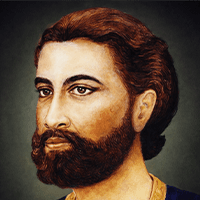
Mir
One of the greatest masters of the Urdu ghazal — the poet of pain, whose tender, sorrowful voice shaped the language itself.
Mir Taqi Mir was born in Akbarabad — today's Agra — around 1722, into a family of very modest means. His father was a devout man of deep spiritual leanings who hoped his son would walk the same path of piety, and arranged for a young admirer of his, Syed Amanullah, to mentor the boy. Neither lived long enough to see what Mir would become. Orphaned of that guidance at around eleven, he was left to fend for himself — and would go on doing so, in one form or another, for the rest of his life. A Life Without Shelter In search of a living, Mir went to Delhi, where a kind man named Khwaja Mohammad Basit introduced him to a nobleman whose patronage gave him brief relief — until the nobleman was killed resisting Nadir Shah's invasion. Cast adrift again, Mir drifted between Delhi and Agra, leaning on the irregular support of various patrons to meet his daily needs. He suffered deeply in his own life, and he also lived through history's cruelty: the sack of Delhi by Nadir Shah and Ahmad Shah Abdali, and the slow collapse of the Mughal Empire. As the ruined city emptied of its men of taste, Mir too left, accepting an invitation to Lucknow. There he found ease at last — but his fiercely sensitive nature would not let him rest. He withdrew from his patron's favour, retreated into solitude, and bore his sorrow alone. Happiness was only ever a short season for him; pain was the constant. He lived without a fixed address, and in a sense without one in death too, for the place of his burial was lost when railway tracks were later laid nearby. The Architect of the Urdu Ghazal Mir is often remembered as a poet of anguish, but his greatness lies in something larger — the way he gave shape to the deepest questions of existence, refined a form, and brought the language of the ghazal to a kind of perfection. What sets his poetry apart is its complete sincerity; he wrote about nearly every aspect of life with a disarming, unguarded honesty. He left behind a vast body of work, including six collections of Urdu ghazals, alongside an account of the Urdu poets before him, an autobiography, and a portrait of Sufi saints. Poet, biographer, and critic at once, Mir holds a place near the very source of the Urdu literary tradition — and centuries on, his voice still feels startlingly close.